Two queries showed up in our search data with almost no traffic attached: crm order management and order tracking management system. Both rank us by accident today. Both describe a job WooCommerce merchants already have.
They want to see who the customer is, what they bought before, where the shipment is, and what to do next — without exporting WooCommerce into a generic CRM that does not know tax or stock.
What people mean by “CRM order management”
In software-vendor English, a CRM owns contacts and pipelines. In merchant English, it means:
- Open an order and immediately see lifetime value, previous tickets, and tags
- Find a person by email or phone without knowing the order number
- Change status, add a note, and keep moving
- Not bounce between WooCommerce, Gmail, and a spreadsheet
That is operations, not sales-pipeline theatre. You can buy HubSpot and sync orders. You will still fulfil in WooCommerce.
What people mean by “order tracking management system”
Sometimes they want a customer-facing tracker. Sometimes they want an internal board of “label created / in transit / exception”. WooCommerce already stores tracking if your shipping plugin writes it to order meta (and Woo 10.7’s beta Fulfilments API is trying to standardise that).
The missing piece is usually visibility for the team, not another public page. A shop manager should see exceptions without building a custom report.
Build the CRM layer on WooCommerce, not beside it
A practical stack:
- WooCommerce as the ledger. Orders, refunds, subscriptions, coupons.
- A dense customer view. Orders for that email, not a WP user screen that hides guest checkouts.
- Search that treats customers as first-class. Guest orders are most of many stores.
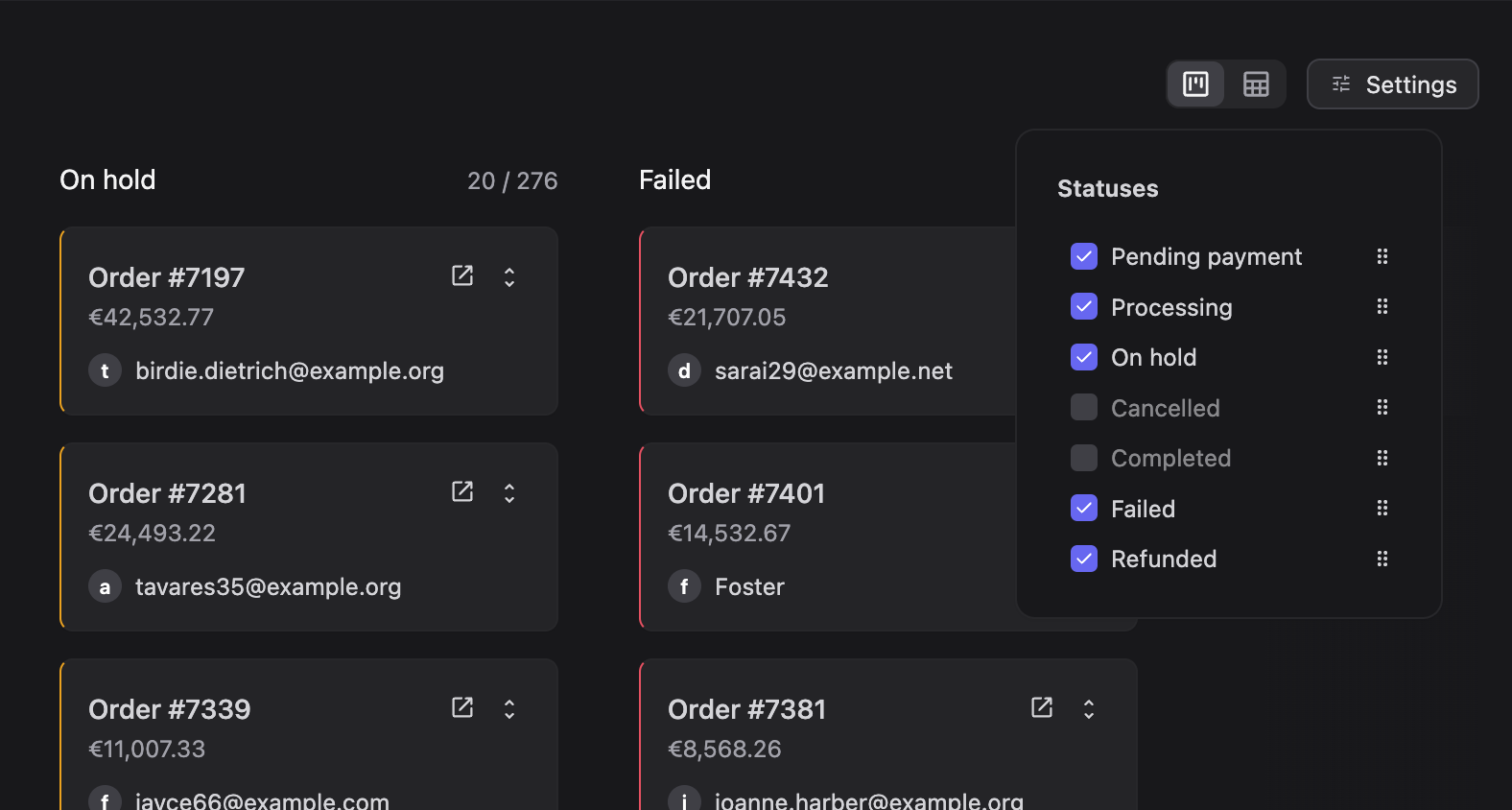
- A fulfilment view. Table for search, kanban for the open queue.
- Notes that stay on the order. If it is not on the order, it did not happen.
Add a dedicated helpdesk if ticket volume justifies it. Do not make the helpdesk the order database.
Where VendBase sits
VendBase is not a full CRM and we will not pretend it is. It is a WooCommerce admin with customer views built for store teams: history, context, and the next action on the same screen as the order.
Global search covers orders, products, and customers. Live updates keep the “new order” moment in the same UI as the CRM-style record. If staff should not see WordPress, load it on the frontend.
ACF fields you already use on products or orders can surface in the interface — we shipped that integration for stores that outgrew the default meta boxes.
When you should still buy a CRM
Buy a CRM if you have a sales team working outbound, a long B2B quote cycle, or marketing automation that is not Woo-shaped. Sync orders into it. Keep fulfilment and stock in WooCommerce. Use VendBase (or core) for the people who pack and refund.
If your search was really “I want order tracking and customer history without another monthly bill”, start with a better WooCommerce admin. One licence, lifetime updates.
Leave a Reply